
Executive Summary
IT support and cybersecurity are often used interchangeably, but they serve different purposes within an organisation.
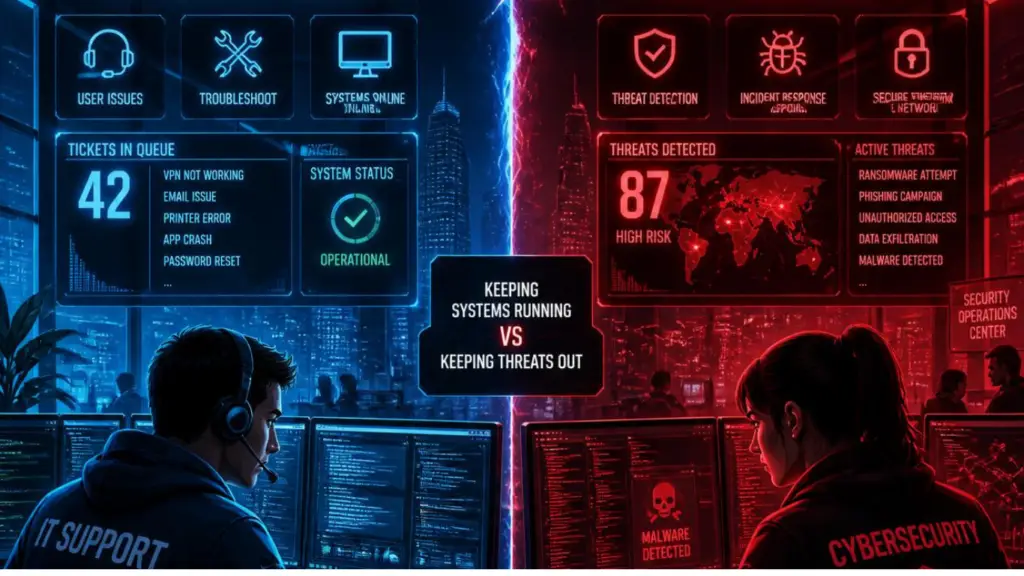
IT support focuses on keeping technology running efficiently so employees can perform their daily work. Cybersecurity focuses on protecting business systems, information and operations from cyber threats while reducing the impact of security incidents.
Both functions are important, and one does not replace the other. Organisations achieve stronger business resilience when IT operations and cybersecurity work together.
Why Are IT Support and Cybersecurity Often Confused?
For many SMEs, a single IT service provider manages computers, email, networks and user support. As a result, it is easy to assume that cybersecurity is automatically included.
While many IT providers offer security-related services, their primary responsibility is often maintaining the availability and performance of business systems.
Cybersecurity takes a different perspective. Instead of asking, “Is the system working?”, cybersecurity asks, “Is the system adequately protected against today’s threats?”
Although these questions are related, they require different skills, priorities and objectives.
What Does IT Support Focus On?
The primary objective of IT support is to ensure that employees can work productively with minimal disruption.
This typically includes setting up computers, resolving technical issues, maintaining networks, installing software, managing printers, supporting Microsoft 365 and helping users when technology does not function as expected.
Success is often measured by system availability, response times and user satisfaction.
IT support plays an essential role in keeping business operations running smoothly.
What Does Cybersecurity Focus On?
Cybersecurity focuses on protecting the organisation against evolving cyber threats.
Rather than concentrating only on whether systems are operational, cybersecurity considers how attackers might compromise those systems and what impact a successful attack could have on the business.
This includes protecting user identities, reducing vulnerabilities, strengthening access controls, monitoring suspicious activities, preparing for cyber incidents and helping organisations recover when incidents occur.
Cybersecurity also supports governance, risk management and regulatory compliance, making it a business discipline rather than simply a technical function.
Why Both Are Important
Imagine your office experiences an internet outage.
IT support works to restore connectivity so employees can continue working.
Now imagine an employee unknowingly enters their Microsoft 365 password into a phishing website.
Although email may continue functioning normally, the organisation could already be experiencing a cybersecurity incident.
The first situation affects productivity.
The second affects business risk.
Both require different expertise, and both are equally important.
Cybersecurity Is Becoming a Business Responsibility
The role of cybersecurity has expanded significantly over the past decade.
Customers increasingly expect organisations to safeguard sensitive information. Business partners want confidence that vendors can protect shared data, and many organisations now include cybersecurity questions during supplier evaluations.
Cybersecurity is therefore no longer limited to the IT department.
It influences customer trust, business continuity, regulatory obligations and organisational reputation.
For many businesses, cybersecurity has become an important component of corporate governance and risk management.
Does Your Business Need Both?
The answer depends on the organisation’s size, industry and level of cyber risk.
Many SMEs continue to rely on an IT provider for day-to-day technical support while engaging cybersecurity specialists to assess cyber risks, improve security governance and strengthen their overall security posture.
This approach allows each discipline to focus on its respective area of expertise while working together to support the organisation’s business objectives.
Rather than replacing IT support, cybersecurity complements it.
Business Perspective
Business owners should not think of IT support and cybersecurity as competing services.
A useful analogy is healthcare.
A general practitioner helps maintain your overall health and treats common illnesses. When specialised treatment is required, you are referred to a cardiologist, neurologist or orthopaedic specialist.
The same principle applies to technology.
IT support keeps your technology operating efficiently. Cybersecurity specialists focus on reducing cyber risk, improving resilience and helping organisations prepare for increasingly sophisticated cyber threats.
Both play important roles in supporting a healthy business.
Frequently Asked Questions
Isn’t IT support responsible for cybersecurity?
Many IT providers implement important security measures as part of their services. However, cybersecurity extends beyond maintaining technology and includes risk management, governance, incident response, security monitoring and organisational resilience.
Can my existing IT provider also provide cybersecurity?
Some IT providers have developed strong cybersecurity capabilities, while others focus primarily on IT operations. Organisations should understand what security services are included and whether they adequately address the organisation’s cyber risks.
Do SMEs need a dedicated cybersecurity provider?
Not every SME requires a dedicated in-house cybersecurity team. However, organisations should ensure they have access to appropriate cybersecurity expertise, particularly when managing sensitive information, supporting customers or preparing for recognised cybersecurity frameworks.
Is cybersecurity only about preventing hackers?
No. Cybersecurity also helps organisations prepare for incidents, minimise business disruption, protect customer information, strengthen governance and recover effectively if an incident occurs.
How do I know if my business needs additional cybersecurity support?
A cybersecurity assessment helps organisations understand their current security posture, identify potential risks and determine whether existing IT and security arrangements adequately support business objectives.
How Viperlink Can Help?
Technology and cybersecurity should work together to support business success.
Viperlink partners with organisations to strengthen their cybersecurity posture through assessments, governance, Microsoft 365 security reviews, virtual CISO services, Cyber Essentials and Cyber Trust readiness, managed security services and practical risk-based recommendations. Our objective is to help businesses make informed cybersecurity decisions while complementing their existing IT operations.
In this article:
IT support keeps your business running. Cybersecurity protects it from cyber threats. Learn the key differences and why businesses need both.
Share on social media:
Facebook
Twitter
LinkedIn
Telegram