
Executive Summary
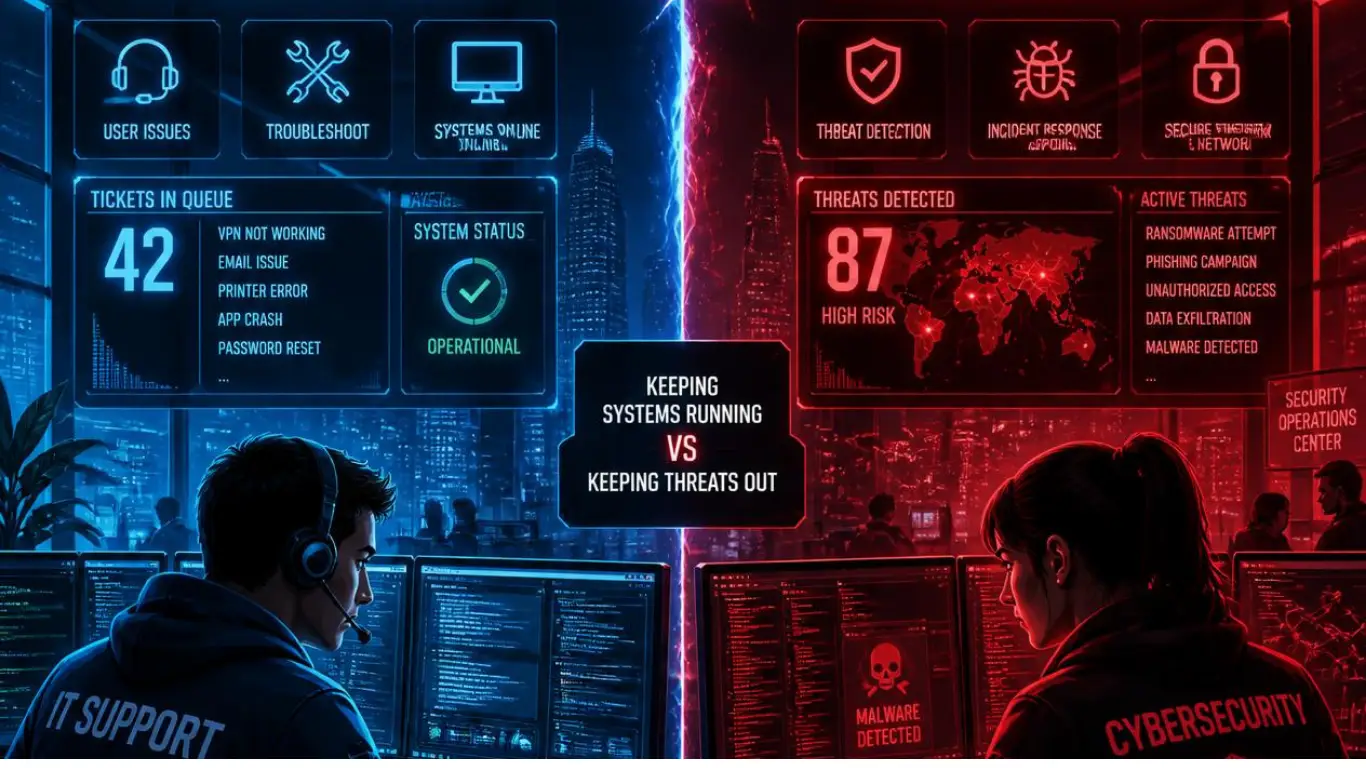
Many organisations assume that their internal IT team is responsible for cybersecurity. While IT teams play an important role in maintaining secure and reliable technology, cybersecurity has evolved into a specialised discipline that extends beyond day-to-day IT operations.
Whether an internal IT team can manage cybersecurity depends on the organisation’s cyber risks, available expertise, business requirements and security objectives. For many organisations, the question is not whether their IT team is capable, but whether they have sufficient cybersecurity capability to address today’s evolving threats.
Why Many Businesses Believe Internal IT Is Enough
For many SMEs, the internal IT team is the first point of contact whenever technology problems arise.
They set up computers, manage Microsoft 365, troubleshoot network issues, install software and support employees with their daily technology needs. Since cybersecurity is closely related to technology, it is understandable why many business owners assume the same team is also responsible for protecting the organisation from cyber threats.
In reality, cybersecurity has become much broader than maintaining IT systems.
As cyber threats become more sophisticated and customer expectations continue to increase, organisations are expected to manage cyber risks through governance, security processes, user awareness, incident response and continuous improvement. These responsibilities often extend beyond the traditional scope of IT support.
IT Operations and Cybersecurity Have Different Objectives
An internal IT team is generally responsible for ensuring technology remains available, reliable and supports business operations.
Cybersecurity, however, focuses on understanding how attackers may compromise systems, how risks can be reduced, how suspicious activity can be detected and how the organisation should respond if an incident occurs.
Both disciplines complement each other, but they require different knowledge, planning and priorities.
An organisation can have excellent IT support while still having cybersecurity gaps that increase business risk.
Cybersecurity Has Become More Than a Technical Function
Modern cybersecurity is no longer limited to installing antivirus software or configuring firewalls.
Organisations are increasingly expected to understand cyber risks across people, processes and technology. This includes protecting user identities, reviewing cloud security configurations, developing incident response procedures, improving employee awareness, managing third-party risks and demonstrating cybersecurity maturity through recognised frameworks where appropriate.
As businesses become more connected to customers, suppliers and cloud platforms, cybersecurity has become an important part of business governance rather than simply an IT responsibility.
Can One Person Do Both?
In some organisations, particularly smaller businesses, one individual may perform both IT operations and cybersecurity responsibilities.
There is nothing inherently wrong with this approach.
The challenge arises when cybersecurity becomes increasingly complex while the IT team continues to manage daily operational responsibilities.
Supporting users, maintaining infrastructure, responding to technical issues and delivering technology projects already require significant time and expertise. Adding cybersecurity governance, threat monitoring, incident response planning and compliance responsibilities may stretch available resources.
Rather than asking whether one person can perform both roles, organisations should consider whether sufficient time, skills and resources are available to manage cybersecurity effectively.
The Better Question to Ask
Instead of asking: “Can our internal IT team handle cybersecurity?”
A more useful question is: “Does our organisation have the cybersecurity capability needed to manage today’s business risks?”
The answer will differ for every organisation. Some businesses may have experienced IT professionals with strong cybersecurity knowledge. Others may benefit from external expertise for specific areas such as cybersecurity assessments, governance, Microsoft 365 security reviews, incident response planning or preparing for frameworks such as CSA Cyber Essentials and CSA Cyber Trust.
Cybersecurity should be viewed as a capability that supports the business, regardless of whether it is delivered internally, externally or through a combination of both.

Business Perspective
Business owners should avoid viewing cybersecurity as an additional IT task that can simply be assigned to whoever manages computers and networks.
Technology continues to evolve rapidly, and cyber threats evolve even faster.
The organisations that manage cybersecurity most effectively are those that recognise it as an ongoing business capability requiring appropriate planning, expertise and continual improvement.
The objective is not to replace the internal IT team. It is to ensure the organisation has the right combination of operational IT support and cybersecurity expertise to protect the business.
Frequently Asked Questions
Can an internal IT team manage cybersecurity?
Yes, in some organisations an internal IT team may have the skills and resources to manage cybersecurity effectively. However, this depends on the organisation’s size, business requirements, available expertise and cyber risks.
Does every SME need a dedicated cybersecurity team?
No. Many SMEs successfully combine internal IT support with external cybersecurity expertise. The important consideration is ensuring that cybersecurity responsibilities are adequately addressed rather than assuming existing IT resources are always sufficient.
Does having an IT department mean my business is secure?
Not necessarily. An effective IT department supports technology operations, but cybersecurity also involves governance, risk management, security monitoring, employee awareness and incident response. Organisations should periodically evaluate whether these areas are adequately covered.
When should a business engage external cybersecurity expertise?
Businesses often seek external cybersecurity support when preparing for certifications such as CSA Cyber Essentials or CSA Cyber Trust, responding to customer cybersecurity requirements, conducting cybersecurity assessments or strengthening governance and risk management.
What questions should I ask when evaluating IT support and cybersecurity services?
Choosing an IT provider or cybersecurity partner is not simply about comparing prices or response times. The more important consideration is understanding how well your business is protected against today’s cyber threats.
Rather than asking, “Do you provide cybersecurity?”, consider asking:
- How do you protect our Microsoft 365 environment from phishing attacks and account compromise?
- How do you detect suspicious or malicious activity before it affects our business?
- What is your incident response process if we experience a cyberattack
- How do you help us reduce cybersecurity risks rather than simply resolving IT issues?
- How do you support organisations preparing for CSA Cyber Essentials or CSA Cyber Trust?
- How often do you review our cybersecurity posture and recommend improvements?
- What support is available if a cybersecurity incident occurs outside business hours?
These questions help organisations understand whether their existing arrangements focus primarily on IT operations or whether they also address the governance, monitoring and risk management needed to strengthen cybersecurity.
How Viperlink Can Help?
Every organisation has different technology resources, business objectives and cybersecurity challenges.
Viperlink works alongside internal IT teams, managed service providers and business leaders to strengthen cybersecurity capabilities through assessments, governance, Microsoft 365 security reviews, Virtual CISO services, managed security services and readiness programmes for CSA Cyber Essentials and CSA Cyber Trust.
Our objective is not to replace your IT team, but to complement it with the cybersecurity expertise needed to protect your business and support long-term resilience.
In this article:
Can your internal IT team handle cybersecurity? Learn when IT support is enough, where specialist expertise adds value, and how to reduce cyber risk.
Share on social media:
Facebook
Twitter
LinkedIn
Telegram